Showing posts with label self-portrait. Show all posts

Tuesday, March 30, 2010

What's A Guy Like You Doing In A Blog Like This?


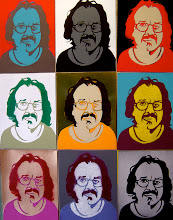
I started Portrait of the Artist as an Old Man at the beginning of January. It is a yearlong project of self-portraiture and writing to mark my sixty-fifth birthday, which will happen on May 14. This is the year I officially become an old guy and the blog is one means of paying attention to an important milestone in my life. My original concept was that I would document the year by creating a self-portrait once a week and writing a reflection on aging. Now I am one quarter of the way through and it feels like a good time to do some assessment and course correction.

A guy I know, Jeff Elsbecker, sent me an update of what he has been up too over the last year. He is an artist and designer. The document he emailed me was a well put together collection of words and pictures telling about his art, his teaching, and his family. It included a sweet story of taking his son out for his first legal beer on his twenty-first birthday.

In a subsequent email, Jeff wrote me, “I'm always conflicted about sending out my now semi-annual 'journal entry'. It's basically the same as a 'Christmas letter'. The reluctance may be midwestern self-effacement. Maybe it's low self-esteem. Maybe it's a healthy check on being egotistical that I should listen to.

Beyond whether I should do it, I have a continuing curiosity as to why I do it. The urge to blog … hmmm . . . where do you think that comes from? Why do you? “

I wrote back to Jeff as follows:

I decided to do the blog for a few reasons:

1. I wanted to pay really close attention to this year in my life. I think of turning sixty-five as a big deal. Like your son’s transition to manhood at 21 that you wanted to pay attention to. This year is my transition to being officially old. Oldguyhood?
2. For quite a while the idea of doing a series of self-portraits as a way of documenting a year had been floating around in my head. I tried it once before. Actually, I tried to do one a day for a year, but I ran out of steam around #30. One a week seems more manageable
3. I love to write and this gives me a discipline that keeps me at it.
4. I thought other people would find it interesting and maybe get something to think about out of it.

So how has it been going?

For me, great! I love doing this blog.

Coming up with a self-portrait a week is a challenge. I’ve been fudging it by using old ones and portraits that other people have done of me. I may bend the rules even further and say that since any artwork is a self-portrait on some level, this painting of roosters counts. (I gave one of my rooster paintings to a friend for his birthday and wrote on the back, “Old Roosters: Too tough for stew, but still able to cock-a-doodle-doo.”)

I am very gratified and stimulated by the comments that people share with me. For example Jeff wrote:
"I wanted to comment when I read your first entry, way back, but didn't explore how to sign up and then just kept forgetting to check in.
In particular I was thinking about Miss America. As a kid she was the icon that we males were to desire. And it wasn't an egregious duty, at least for me. The point where I jerked the end of my leash was when I realized if I pursued her now I'd be a pedophile."

This is a good point for you to share your assessment of Portrait of the Artist as an Old Man. I’d love to hear comments, suggestions, questions, and/or criticism.

Tuesday, March 9, 2010

The Life-O-Meter


I’ve been making comfort food for Mary and Glen.
Lasagna, chili con carne, tamale pie, beef stew, macaroni and cheese.
I drop it off at their house, sometimes stay for a beer.
By the time you read this, their baby will have been born.
(Yes, indeed! His name is Rio Hunter Vieira Spears. I knew they would have a boy.)
In the ninth month, cooking for them means one less thing they have to do for themselves.

Brie is 87 or 88.
He can’t tell me which.
He can only remember the last thirty seconds of his life.
When I say, “Brie, its John Kotula, from your Sunday morning drawing group,” he remembers “…morning drawing group.” Then he forgets that.
A year ago he knew he knew me.
That level of recognition made him smile.
Now he doesn’t know who he doesn’t know.

Even without the pregnancy, Mary and Glen are full of life.
They are young, beautiful, physical.
You don’t have to know them long to learn that they first made love on the ground, in a vineyard, during a rainstorm.
Mary was keeping her distance when they met working for a landscaper.
Glen had faith in his motorcycle.
If he could get Mary to go for a ride, she would realize being with a tattooed, bow hunting, air force veteran was better than being with girls.
Mary got on behind.
The rains came.
Glen was right.
Who would have bet on that?

I met Brie when he was in his late sixties.
He was a great storyteller.
Even though he told the same stories, retold them and then told them again.
Brie joined the American army as soon as Germany invaded France, his mother’s homeland, the place of his birth.
He ended up in Texas.
He got stuck there because the army found out he could draw.
He stood at a blackboard on a drill field in front of illiterate recruits.
He drew each part of their rifles.
He drew how all the parts fit together.
What did they make of him in Texas with his French accent, his Harvard education and his Cary Grant looks?
He kept asking to fight.
Finally, the army agreed he could go.
They even asked if he wanted to go to Europe or the Pacific.
“Most certainly to Europe,” he replied. “I want to kill Germans.”
In France, Brie was again over qualified for killing or being killed.
Anybody could do that.
Few could read, write, and speak perfect French.
He spent the war as an aide-de-camp to a general.

Mary and Glen moved to Alaska, to a town you have to fly into, a town with no alcohol, but plenty of kids with fetal alcohol syndrome.
Mary was the town’s schoolteacher. Glen also worked for the town, in a training program for dropouts.
A year of isolation, of being the only white people, was a long time.
They almost stayed, but in the end they came home.

After the war Brie went to art school in New York City on the GI Bill.
He taught at several top tier art schools.
Andy Warhol once tried to give him a painting. He turned it down. He thought it was ugly and thought Warhol was trying to pay him for sex, making an already awkward situation worse.
He surprised Leonard Bernstein by refusing to sleep with him two nights in a row. He found Bernstein’s sense of entitlement unbearable.
He wrote an influential article about the “new plastic paints” before serious artists were using acrylics.
Brie’s book on the design principals of natural objects is still in use.
He moved to the Midwest to be the dean of art schools in Chicago and Indianapolis.
Eventually he retired to Rhode Island where he had kept a summerhouse for years, a short bicycle ride to the beach.

Mary wanted a cast of her pregnant torso.
She knew I could do that kind of thing, so she asked me to help.
I went over armed with a jar of Vaseline and plaster of Paris gauze strips.
Glen and I dipped the gauze in a bowl of warm water and smoothed them onto Mary’s body from neck to thigh.
I asked Glen for a beer.
He said, “So, you’re going to feel up my wife and drink my beer.”

Mary is worried about her students at the alternative high school where she works.
They are seniors and when the baby is born she will be on leave for several weeks.
There is no question that several of her students lean on her and won’t function as well without her daily support.
She is the teacher you wish you had when you were sixteen.

Brie lives in The Carriage House at The Elms in Westerly.
He used to have his own room. Now he’s in a double.
He used to have one of my drawings over his bed. Now there’s no decoration.
I don’t know how to decode these changes.
We sit together on a small sofa across the room from a big screen TV.
Several residents sit in front of the TV watching bowling.
I talk to Brie.
He occasionally mumbles polite phrases that don’t quite match what I said.
“Yes, yes… I’m sure,” “How nice… Thank you.” “Good… yes, good.”
Soon he closes his eyes and lets his head fall to his chest.

I have an image of myself teetering between Mary and Glen on one end of a seesaw and Brie on the other.
If the unit of measure is years, I’m closer to Brie.
If we use the Life-O-Meter, I’m closer to Mary and Glen.
In the wink on an eye, I could lose my grip, slide down to Brie’s end, hoist Mary and Glen up into the sky, full of life, laughing, all by themselves.

About the Portraits:
It took me awhile to find these. I had to go through a lot of old drawings, which is always a pleasant process for me. A couple of time Brie and I got together and took turns drawing each other. The top picture is one of my portraits of him and the next is one he drew of me. I think they are from about 2001. That is a guess, based in part on me looking pretty thin. I was skinny for a couple of years around that time.

Tuesday, February 16, 2010

Memory Lapses, Part I - Who Are You?


Twice in one day, I ran into people who knew me by name that I didn’t recognize. The first time this happened, I had gone into a cafĂ© in Newport to have lunch with a friend. As we were taking our seats a young, good looking woman at a nearby table looked at me, smiled broadly, and said, ‘Hi, John.” I knew I knew her, but couldn’t place her at all. She was with a man who hadn’t acknowledged me and whom I was pretty sure I didn’t know. The only glimmer of recognition I had was a sense that she was out of place. I felt that I shouldn’t have been running into her in Newport.

After lunch, I stopped at her table and said, “You’re not usually over this way.” “No,” she replied. “You neither.”

“Actually, I’m the arts coordinator at The East Bay Met School. I work there three days a week, so I’m in Newport quite a bit.”

Pause.

“And you?” I asked.

“I’m here seeing some massage clients.”

Of course! She was a massage therapist I’d gone to three or four times. She saw clients in the old mill building in North Kingstown where I had my art studio. She gave a break to other tenants in the building making her services quite affordable. Once I made the connection, my recognition of her was complete, my memories intact. I don’t think she realized that I hadn’t recognized her.

Later the same day, I went into Belmont’s to buy ingredients for soup. The woman checking me out, said, “Hi, John.” I looked at her with no sense or recognition. She was a thin, attractive woman about my age, but I had no idea who she might be to me or me to her.

She said, “Its Diane.”

Nothing.

“I took pottery lessons from you when you had your shop on Main Street.” I had the shop thirty-five years ago.

“I’m the one that made all the lopsided bowls.”

“Everyone who studied pottery with me made lopsided bowls,” I said.

We chatted a bit but no memories emerged for me. Nothing.

When my wife Deb and I are together, we have a signal worked out. If I should be able to make an introduction, but I am drawing a blank, I say, “Have you two met?”

Deb sticks out her hand and says, “Hi I’m Debby Drew, John’s wife.”

Usually, but not always, the person will complete the introduction and I’m off the hook.

Sometimes there is no choice but to say, “Look, I’m terribly sorry. I know I know you but I can’t place you.” People are generally very kind about this. They laugh it off.

These lapses are pretty common and have been going on for quite awhile. I think they are happening more frequently, but I don’t think they are completely age related. For example, I’ve never been able to remember numbers. I don’t actually mind these memory short circuits for myself. It is a minor inconvenience. However, I worry about how it makes other people feel. I guess I just have to trust that they will know it is a cognitive limitation and is not a reflection of how I regard them.


About the self-portrait:
I took a workshop in botanical illustration from a woman named Gretchen Halpert (http://gretchenhalpert.com/Home.html). This workshop involved spending two days in February in the greenhouses at Roger Williams Park, while it was in the 20's outside, drawing tropical blossoms. Gretchen pushed the participants to do slow, accurate drawings. A couple of days later I did this pencil self-portrait. The workshop and this drawing reminded me of a way of working that I don't often use, but that I have available.