Showing posts with label drawing. Show all posts

Tuesday, June 8, 2010

Portrait of the Artist as a Young Zombie


You’d think that after all these years I’d be better at predicting my own reactions. Not the case. I keep getting surprised. When they got dad, I was all business. I took the chainsaw to him, neatly severing his head from his body, soaked him in gasoline and lit him up. A half hour later I was back inside the perimeter, drinking a beer, toasting him with some of the other hunters just back from patrols. Of course dad was damn near seventy years old and had no business still going hunting outside the perimeter. I could say he’d led a good life and died a good death and believe it.
Moses was a whole different story. He hadn’t check in for more than a day and a night so I pretty much knew he was gone. I should have been prepared. Then I spotted him. He was part of a group of four who were tearing apart a fresh kill. I just fell apart. Well not really. I got the job done. I sprayed them and lit them up, I kept the spot light on their flaming corpses until I was sure their brains had boiled out, but the whole time I was shaking and I felt like I couldn’t suck in enough air.
After they opened the gate for me, I drove up the road a hundred yards, pulled into a field, and turned off the headlights. I took my Smith and Weston out of the waistband of my jeans and put the barrel in my mouth. This was my way of posing a question to myself, “Live or die, motherfucker?” The question had more urgency than usual because Moses was the last of my family and because he was only twenty-one years old. Some girl once referred to him as the Peter-Pan of the Scranton stockade. More than once, I had said to him, “When you going to grow up, asshole?”
He’d respond, “You ever notice how when people say that, they mean they want you to stop doing something you’re having fun doing? So John, I’d say maybe never.”
Sitting in the pick-up with the gun barrel clattering against my teeth, I thought, “That’s sure as shit true now, you little prick.” Then I started to cry. Really squirting them. It’d been years. I wet my cheeks, the barrel of the gun, my shirt. Then I started to laugh at myself and I had to take the gun out of my mouth because I was gagging on it.
“I’m alive,” I thought. I bet twenty years ago, people thought alive was the opposite of dead, but of course I knew that alive was the opposite of un-dead. So I stuck the gun back in my pants and drove on toward the barracks.
It was only then that I thought, “Who in the hell were they eating? Who was out there? Were there survivors?”


For the last two years Moses Leonard-Fritzmeier has been assisting me with the art program I run at the East Bay Met School. He graduated from the school just about the time I started, but has extended his involvement with the school by taking on a part time job there. When I first met Moses I thought I would talk him into going to art school. These days I’m less convinced I know what is best for him.
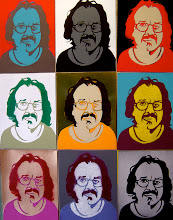
Late in the school year, on a quiet day, we worked on a portrait swap. I drew him and he drew me. Earlier in the year, Moses had done a large poster of a zombie pizza boy delivering to a cemetery, where a fist clenching dollar bills to pay for the pizza stuck out of a fresh grave. I much admired this piece of artwork. We decided to portray each other as zombies. As we worked, I asked Moses questions and tried to develop more of a sense of who he was as a young artist. I hoped to learn more so I could write about our similarities and differences and compare him as a young artist to me as an old artist.
Zombies were also on my mind. I found myself starting conversation with friends with questions like, “Will zombies eat any body part or do they feed exclusively on brains?” “How do you kill a zombie?” “Do zombies reproduce?” I found a surprising number of men, even men my age, have very strong opinions on zombies. Women tended to roll their eyes.
One day, Lily Quinn, an art student, joined us and said, “Moses, you are the Peter Pan of The Met School.”
I asked, “So, Moses, what would it mean to you to grow up?”
He said, “That’s a good question. I always want to have a child like attitude. When you are little and people tell you to grow up, they usually mean to stop doing something you’re having fun doing. I don’t want to grow up in that way. Of course there is a part of growing up that is about physical maturity and taking responsibility for your own actions.”
Mose is twenty-one. As he spoke I thought about myself as a twenty-one year old. I was married. I had an apartment that I paid the rent on. I took a full load of classes at Queens College. I worked in a community center in a Black and Puerto Rican section of the borough. I protested the war in Vietnam. On weekends, I went into The Village to attend Jefferson Airplane concerts at the Fillmore East. In the summer, I heard Nina Simone sing at the Wolman Skating Rink in Central Park. I took myself very seriously. Too seriously. I wanted to be an artist, but decided it would be a socially irresponsible choice. I thought my work should contribute to the community. I studied sociology and later education. I became a teacher.
When I was twenty-one, if someone had referred to me as Peter Pan or in some other way indicated I needed to grow up, I would have been incredulous and hurt. Forty-four years later, I’m going around initiating conversations about zombies.

In the morning I woke up bereaved, the last of the Buckinghams. I also woke up pretty suicidal-slash-murderous due to the fact I had to get up and had to do something about the slim possibility that there might be living people outside the perimeter. Let me be clear, I don’t mind getting up and I don’t mind running patrols, as long as I’m doing it of my own free will. However, to be compelled to do it because some idiot was out there offering himself up as a brain sandwich really pissed me off. Maybe I’d like to mourn my brother, maybe I’d like to get drunk, maybe I’d like to go into town and look for some company. In lieu of these options I went out to the courtyard of the barracks where there was a swimming pool, a basketball court, and an old neon sign that said Top of the 80’s Motel, which is what the barracks was before the perimeter was expanded and my group of hunters started using it as our headquarters. I turned the volume of the sound system way up and started dancing. The first tune was Volunteers by The Jefferson Airplane:


Look what's happening out in the streets

Got a revolution got to revolution

Hey I'm dancing down the streets

Got a revolution got to revolution

One generation got old

One generation got soul

This generation got no destination to hold

Got a revolution, got to revolution

Who will take it from you?

We will and who are we?

We are volunteers of America


I danced all over the basketball court, strutting and high kicking from one end to the other. I did leaps and spins. Dropped to my knees. Did splits. Walked on my hands. Clapped along. Played air guitar.

Next up was Nina Simone singing Sinnerman.
Oh sinnerman, where you gonna run to
Sinnerman, where you gonna run to
Where you gunna run to
All on that day
So I run to the lord
Please help me, lord
Dont you see me prayin'
Dont you see me down here prayin'
But the lord said
Go to the devil, the lord said
Go to the devil
He said go to the devil
All on that day
So I ran to the devil
He was waiting
I ran to the devil, he was waiting
All on that day


By the end, I was drenched in sweat and panting. However, I was motivated, energized, and ready for what lie ahead. There is no better way to get ready to do what needs to be done.
While Nina was singing and shaking the tambourines, Cary, Graham, and Julian had come out of their rooms. Like me, they had woken up early, put on a pair of gym shorts and sneakers, and were ready to start the day dancing. Without discussion, we stood in a two by two formation, leaving Moses place in the center empty, and waited for the first notes. Without missing a beat we started the routine. We knew every move; every glide, every twitch, every thrust of the hips. We’d done it hundreds of times.

It's close to midnight and something evil's lurking in the dark

Under the moonlight, you see a sight that almost stops your heart

You try to scream but terror takes the sound before you make it

You start to freeze as horror looks you right between the eyes

You're paralyzed


'Cause this is thriller, thriller night

Darkness falls across the land

The midnight hour is close at hand

Creatures crawl in search of blood

To terrorize y'alls neighborhood


I'm gonna thrill ya tonight, ooh baby

I'm gonna thrill ya tonight, oh darlin'

Thriller night, baby, ooh!


The foulest stench is in the air

The funk of forty thousand years

And grizzly ghouls from every tomb

Are closing in to seal your doom


Moses said, “In the morning, I’m pretty suicidal-slash-murderous due to the fact I have to get up.
In general, I have a pretty weak work ethic. I’m lazy. Sometimes I try and make myself do something, but usually I just wait until I want to do it.”
I asked him how often he draws.
He said, “Sometimes everyday. At least every week.”
He added, “Sometimes I get stuck and do the same thing over and over again. That’s pretty good because it becomes second nature.”
I have been drawing continuously, at times obsessively, for more than fifty years. My choice of materials comes and goes and comes back again: pencils, charcoal, conte, ink, crayons, china markers, pastels, chalk. Over the years, I have drawn anything and everything (with the human figure as a constant) : portraits, self portraits, apples on reflective surfaces, Chinese take out cartons, Wonder Woman’s glass airplane, rubber animals, nuns, swimming goggles, copies of Caravaggio, Velasquez, Homer, Hopper and Diego Rivera. Through all the changes in materials and subject matter, what has always been true is that I love making marks and seeing them accumulate to reveal an image.
I asked Moses to tell me three events that had affected him.
He said, “Some bad things have happened to me like my sister dying and my parents getting divorced. Some people can turn that negativity into art, but I need positive energy. If I think about the negative stuff, I don’t want to do anything.” He says one place that he gets positive energy is from music. “Just listening to it or playing it helps me get going.”

“How could you fuck a zombie even if you were a zombie?” This was a question Julian frequently posed ever since it became clear about ten years ago that they were reproducing. It was triggered this time because our rescue mission involved extracting a group of the living from an attack by a group of second generation undead.
In deference to my state of mourning, it had been decided that I should have company while looking for anyone else who might have been with the guy Moses and his buddies were eating. I went out in one Hummer with Julian. Cary and Graham were in the other. At the gate, a couple of regulars decided to come along in their army SUV.
We were traveling north toward the New York border on what used to be route 84 when we came upon a ravaged caravan of four armored school buses. One was on its side, one was on fire, and flat tires immobilized the other two. All the vehicles were being swarmed by a group of about fifty second geners.
The second geners were about fifteen years old, but sleek and muscular like good high school athletes. They were also faster and better coordinated than their parents. They were less exclusively nocturnal and maybe a little smarter. While the virus had totally scrambled the upper brain of everyone it originally infected, leaving them with only lower brain functions, the second geners actually seemed to be able to think. It scared the shit out of me to think what the third generation would be like.
Laying waste to the undead is my art form. I do it so well that it transcends all the individual moves and becomes performance on the level of the best athletes, dancers, or musicians. I get into a zone where I am pure action, unmitigated by thought.
The first step was to shoot their legs out from under them. Standing up through the hatch of the Hummer, I aimed my machine gun for their knees and watched them go over like bowling pins. We had one team circling clockwise, one going in the opposite direction, and one on an over pass firing down. It looked like total mayhem, but we were being careful not to shoot each other or fire into the school buses. Soon the ground was covered with crawling, clawing undead. I jumped out with a chainsaw in one hand and a flamethrower in the other and went about assuring that no head was left attached and no brain matter was intact. Julian did his part by driving back and forth over any who had crawled into the road, popping their skulls like cantaloupe. Between the three teams it took us about a half hour to reduce the attackers to a six-inch thick blanket of glistening gore spread across the width of the highway.
We had to do away with about half the travelers as well. The teenage brain munchers had gotten at them through the windows and they were as good as undead. Finally, we divided the fifteen shaking, weeping survivors among our three vehicles, packed them in, and drove them back to Scranton, fifteen of the living who would go on living in safety, well relative safety.

“Sometimes I think of myself as an artist. Not necessarily when I’m drawing. It could be when I’m doing anything. If I’m doing a really good job, really concentrating, I feel like an artist. Anybody can be an artist at what they do if they bring the right attitude to it.”

I have thought of myself as an artist since third grade when my classmates started asking me to draw things for them. For awhile, maybe it was only a week, I spent every recess drawing pages of airplanes, aircraft carriers, and battleships. My friends would then play war by covering the drawings all over with arcing lines that indicated a shot had been fired and scribbles that showed a hit. I missed getting to fight the battles myself, especially making the sound effects, but I loved being recognized for drawing the best armaments.

“I do the best stuff if I’m not trying. I’ll just be drawing and not thinking if it is good or not and I’ll be surprised at how good it comes out. If I try, nothing happens. Athletes say the same thing. After you’ve done it enough, you just get in the zone and let it happen.”

“When I was a kid, I was into fantasy; Star Wars, stuff like that. I used to wish magic was real. It was a natural progression to read philosophy, quantum physics and it turned out magic was real.”

“I try to get in a zen mode where you are always seeing something for the first time. I try not to get in a rut. I look at the world differently

Monday, May 31, 2010

Journal of My Trip to Honduras


May 22, 2010


(My wife, Deborah Drew, and I were Peace Corps volunteers in Honduras from 2005-2007. We went back in November of 2008 and again last week. This post is based on journal entries I made during the latest trip.)


I am sitting on the second floor balcony of the Hotel Guadeloupe II, the hotel where I always stay in Tegucigalpa, Honduras. It is not really a balcony. The hallways are open and there is a low wall and railing that looks out over the street. The doors and windows of the rooms open onto this open hallway.


(How many journal entries have I started with “I am sitting on the balcony of the Hotel Guadeloupe II”?)


There is thunder and lightening. The power is going off and on.


Why am I back in Honduras? Is this the last time or the continuation of an ongoing commitment? Is this the trip where I say good-bye and let Honduras become part of my past or is this the trip where I get clear that international work is a permanent part of what I want my life to be about?


We are in Tegucigalpa to see Hector, a young man from Sonaguera who is in the capital studying medicine. I have my old Honduran cell phone with me. I have at least three numbers for Hector none of which are working. He knows we are here and I feel confident that he will contact us, but what a drag if he doesn’t.


Wait a minute. This is Honduras. Of course things go wrong. Of course the numbers I have for Hector don’t work. Of course the lights are going to go off and on.


May 23, 2010


We spend the day with Hector doing ordinary things that feel extraordinary.


He talks with passion about his studies. Many students have to repeat courses they haven’t been successful in, but he is moving steadily ahead. His only complaint is that he has to share a cadaver with 35 other students and it is in bad condition. It is hard to see the structures they are supposed to be learning about.


We go to the Gourmet Grill for breakfast, walk on Boulevard Morazon looking without success for internet and a new chip for my cell phone, take a taxi to Mall Mega Plaza and see Robin Hood. Then its back to the Guadeloupe for a game of Oh Hell and out to dinner at El Patio.


We say good-bye to Hector.


Deb and I watch the finale of Lost with rolling horizontal stripes on a channel whose signal clicks off periodically.


In other words nothing exceptional happens, so why does every minute feel so resonant? It is not like I don’t have great, full days in my life in Rhode Island. I certainly do, many of them. And yet I can’t deny the power of Honduras for me. I also don’t understand it fully.


May 24, 2010


Eight hours on the bus from Tegucigalpa to Sonaguera. I look out the window the whole time. Taking in the combination of gorgeous scenery and poverty. Memories come to me with every mile. When Deb isn’t reading or knitting, we hold hands and talk. The greenness fills me with emotion. There is no way of holding this greenness in memory. If you are not looking at it, it is gone.


We get off the bus in the afternoon in Planes in a deluge of rain, thunder and lightening. We wait under a shelter where uniformed workers stop cars to check for fruit. We are still a half-mile to the turnoff to Sonaguera, but this is the only shelter. There is a bus coming behind us that will take the turn and go into town. When it arrives 40 minutes later, the rain is still coming down. We know the ayudante on this bus, a heavyset guy who has always been friendly to us. He is glad to see us and surprised that we have returned. We explain, for the first of many times, that we are not staying another two years. We are only visiting.


May 25, 2010


In the afternoon, I sit on the porch of Ligia and David’s house writing. Everyday it is in the 90’s. Every afternoon there are thunderstorms.


The sky turns to slate. All the colors are muted, shifted toward gray.


Yeah! Here comes the rain, just as Legia pulls up on her motorcycle. The dogs are happy to see her. Davissa comes out to unlock the gate. Both Davissa and her mother get speckled with the rain, but it is not until they have the bike under the roof of the porch that the deluge really starts.


I sit and watch the street through their gate. This is the parade that passes:


A boy in a red shirt carrying a large stem of bananas over his shoulder. The bananas must weigh half as much as he does.

A three-wheeled moto-taxi with a sheet of plastic stretched across the door to protect the passengers in the back seat.

A green pick-up truck with steamy windows and a red pick-up with a plastic, five-gallon water jug rolling around in the bed.

A boy on a motorcycle going too fast to catch any details. After he passes, it registers; he was wearing a helmet!

A girl on a bike carrying a huge black umbrella and wearing the universal public school uniform: white blouse, blue skirt. The basket of her bike is full. She stops at the gate and calls out to Davissa. She is delivering tortillas on her way to night classes. Davissa sends her around to the other side of the house where the gate is unlocked.

Two girls on bikes pass going in opposite directions. One has a purple umbrella and wears a green skirt. The other has no umbrella and is wearing a black tank top. They sing out to each other, “Adios,” “Que le via bien.”

The same moto-taxi comes back again.

A few more nondescript pick-ups.

A full sized, bright yellow school bus with lettering that reads Walker-Hackensack Valley, Minnesota Regional School Department.

Out of the corner of my eye, I see something moving through the puddles in the yard. It is a frog about the size of a grapefruit. It hops to the gate and squeezes through the bars. Why did the frog want to leave the yard? Why did the frog cross the road?


It is too dark to write. Mosquitoes I can’t see are probably biting me. Earlier in the day, I saw a map of Sonaguera at the Centro de Salud. It was stuck with two hundred pins clustered in groups around villages. Every pin indicated a case of malaria. I could become a pin in a map.


May 26, 2010


One reason for coming back to Honduras at this time is that William Alvarenga died in a motorcycle accident six weeks ago. We want to see his family, especially his brother Melvin, with whom we are very close. We want them to know that in some small way we share their grief.


The accident happened right in front of the house. Melvin saw it happen. William pulled out of the gas station across the street and rode his motorcycle into the path of an oncoming truck.


We go to the cemetery with the family. I ride in the back of the pick-up with the two youngest kids, Jairo and Jessica. We cross the highway from the house and go into the gas station.


Jairo says, “That’s where my brother was killed.”

I say. “I know. Do you miss him?”

He nods his head and starts to cry.

I say, “I miss him, too,” and start to cry.


William’s grave looks very fresh. It is a mound of loose dry soil covered in plastic flowers, some already fading in the sun. We add our bunch of white plastic lilies. There are no words to say.


May 27, 2010


(In November of 2008, Deb and I went to Honduras with a group of students from The East Bay Met School where I work part time. My good friend and co-worker Mary Vieira went, too. This past February, Mary and her husband, Glenn Spear, had their first child, a little boy they named Rio Hunter. For her baby shower, Mary asked that in lieu of gifts donations be made to help children in developing countries. She designated half of what was raised, $500, to the Clinica Maternal y Infantil in Sonaguera.)


Deb and I talk to several people about Rio’s money. We want Silvia Bardales, a businesswoman and teacher of business at the high school, to manage it and account for how it is spent. We also talk to Nelly, the head of nursing for the town, and to Rosa, the new director of the clinica. They are in agreement with setting up an account with Silvia that they can draw on. Nelly says there is no oxygen in the health center. If babies are born who could use a little oxygen there is no way to give it to them. Maybe they will use the money for a tank and a regulator. It could be used with asthmatics, too. She also mentions that there are a couple of HIV positive mothers in town who can’t breast feed their babies, the money could be used to make sure the babies get formula. Deb reminds her that emergency transportations is often needed. The only ambulance in town is a private one and prohibitively expensive. Rio’s money could fund gas to get to the hospital in LaCeiba.


We plan to find ways to replenish this fund.


Everyone we visit gives us coke. If they know we are coming they feed us soup or fried chicken. I estimate this is a six hen visit. At least six hens give up their lives to make us feel welcome.


May 28, 2010


We leave Sonaguera and go to Tela, my favorite beach town in Honduras. We have a long lazy day at the Hotel Sherwood, looking out at Tela Bay. Tomorrow morning we will go to the airport in San Pedro Sula and fly home by way of Miami and Charlotte.


Here is what I realized on this trip: it is very important to me to go south. Not south to Key West or New Orleans or San Diego, but south to Havana or Managua or Bogotá. It is especially important to me to go south to Sonaguera in Honduras. It is important to me to know the world beyond the boundaries of my own country, to smell other odors, hear other languages, taste sweeter fruit, listen to opinions informed by other experiences, sway to unfamiliar rhythms, learn the names of birds that never fly north of the Rio Grande, feel heat that is only approximated in Miami in August, stand out for the whiteness of my skin, share the street with roosters, cows, horses, pigs, dogs that haven’t been neutered, in addition to bicycles, motorcycles, pick-up trucks and recycled school buses from the US, feel deeply connected to people who are different than me in all particulars, and recognize that they are no different than me.


About the Drawing: The drawing was done by one of the young men in my old neighborhood of Barrio Abajo. His name is Cesar.


Monday, April 19, 2010

Why I'm an Artist: A brief History of my Mother


My mother, Maizie, valued a good story more than she valued the unvarnished truth. If there were two ways to look at an occurrence and one was full of drama, intrigue, unspoken motives, and double crosses, while the other was mundane, day-to-day life, just people getting by, she would always go for the juicier interpretation. I mention this because what follows is based, in large part, on stories she told me. I have no way of verifying their voracity. That is OK with me because true or false, fact or fiction, they are my stories. I grew up on them and was well on my way to being an artist before I realized they might have been less than one hundred percent factual.

The Barrel

My father was an inarticulate guy. He spoke Polish until he was five years old. When he went to kindergarten the nuns taught him English. However, he continued to live in a family and community, Hamtramck, Michigan, where everyone spoke English as a second language. Expressing himself in words never came naturally to him. I think this explains perfectly his technique for picking up women. This was back before the war, maybe 1940. He was already in the navy. He would go to Jefferson Beach Amusement Park in St. Claire Shores and hang out in The Barrel. The Barrel was a rotating tunnel about eight feet in diameter and maybe twenty feet long. It wasn’t hard to master the trick of getting through the barrel. All you had to do was walk into the spin, step up the wall as it was coming down and gradually move in the direction you wanted to go. However, it was totally believable that you might trip up, tumble at the feet of the girl next to you, causing her to go down on top of you, scramble to your feet and try to help her up only to trip again and end up in a tangle of arms and legs on the smooth curve of the polished wooden floor. After all that physical contact, before a word was spoken, it was an easy next step to go o the dance hall for beers and more physical contact. That was how Johnny met Maizie.

Shot From Guns

My mother was orphaned by the time she was two. Her father died hopping freight trains. Her mother, a very young and beautiful widow, caught the attention of an older, politically connected man. When she shunned his advances, he killed her and went unpunished. These events took place in southern Ohio around 1919. An older sister of my murdered grandmother, Callie Stevens, and her husband, Daddy Jim Stevens, raised my mother. They lived in Detroit. My mother’s status in the family was less than an adopted child, maybe more like an indentured servant. She was reminded frequently that she should be grateful to have a roof over her head and food on the table. Another cousin, Hobart, was also raised in the Steven’s household. My mother was very fond of Hobart. The only thing that I can remember about him was that he was obese, fat enough to make an impression on a young child. He was older than my mother and she was older than Callie and Daddy Jim’s three biological children, Jim Jr., Frank, and Mary Jane.

By 1945, my mother and father had been married for five years. I’d been born. The war was over, although my father hadn’t made it home yet, and my mother was sharing a house with Hobart, his wife Lou, and their daughter Sandy, who was only a month or two older than me. Lou was my wet nurse. My mother’s milk hadn’t come in, but Lou had plenty for Sandy and me. We all lived right across the street from Jefferson Beach Amusement Park where my parents had met. Lou worked at the park.

In those days, Jefferson Beach had a carnival midway and Lou performed in two acts. In the first act she was the human cannon ball. Wearing a sequined, red, white, and blue bathing suit, she would wave to the crowd, salute them patriotically, then slide into the barrel of the cannon. The cannon would be raised to the correct angle and a spring mechanism, timed with an explosion of gun powder, would launch her twenty feet over the heads of the spectators and into a huge net. This spectacle served to draw a crowd who would then be enticed to step inside the tent to see several sideshow attractions.

Lou’s second act took place inside the tent where she performed in a tableau entitled The Woman From 10,000 BC. Her performance consisted of donning a wild blond wig and a skimpy leopard skin bikini and lying motionless frozen in a block of ice. Actually there were two blocks of ice with a hollow space in between for her. A coating of Vaseline prevented frostbite for the three minutes the rubes were allowed to ogle her prehistoric curves.

I imagine Lou getting home from work, scooping up Sandy and me and putting us to breast. We would have sucked greedily. At first, the milk would have come out cold from having recently been kept on ice, but as we sucked, it would quickly have warmed up, within seconds it would have been warmer than her nipple. Was the milk a little creamier when feedings followed the human cannon ball act? I think it was. Was there a lingering odor of gunpowder? I think there was.

Little Toot

My favorite ride at Jefferson Beach was Little Toot the kiddy train. Every night part of my bedtime routine was kissing Little Toot goodnight. Every night my mother would carry me across Jefferson Avenue and into the park with its swirling lights, the clacking noise from the big wooden roller coaster, screams and laughter, and smell of cotton candy. She would hold me tight as I leaned out of her arms and planted a smooch on the train’s round, red, plaster cheek. Now, that made for a good nights sleep.

Queen for a day

My mother carried many a grudge in her day. One long running one was against her youngest cousin, Mary Jane. Maizie was a young teenager when Callie and Daddy Jim had Mary Jane. Much of the responsibility for raising her was delegated to my mother. Mary Jane got pregnant and married her boy friend, Tennessee Bowman, by the time she was seventeen. Their first child was named Janet. I can’t reconstruct the sequence of events, but for some period my mother took Janet and was raising her. Then Mary Jane and Tennessee took her back. My mother felt the return of Janet to her parents as a profound loss. About this time it came out that Janet was actually my father’s child. Mary Jane had gotten Johnny drunk and seduced him. She only married Tennessee because Johnny was already married to my mother. I heard my mother make this accusation to my father more than once. He would just mutter, “You’re crazy.”

There was a rift between my mother and her people that lasted several years. Eventually they all reestablished contact and my mother was in touch with both Mary Jane and Janet when she died.

Mary Jane and Tennessee had five more kids. He got lung cancer and was told he’d be dead in a year. Before he had a chance to die of cancer, the furnace in their house blew up on Christmas Eve, killed him and badly burned three of the children. Janet was spared. Mary Jane went on Queen For a Day and asked for money for plastic surgery for the children. As measured by the applause-o-meter, her story was judged far more pitiable than the stories of the other contestants. She won hands down. I don’t know how much money she got for plastic surgery, but she did get a complete make over and a two-week trip to Hawaii.

Later, Mary Jane spent time in prison for passing bad checks. Once, in the early seventies, she called me. I don’t know how she got my number. She told me she was taking care of a very wealthy, older woman. She said when the woman died she would inherit all of her money, but until then she needed money to buy a car. She asked me to loan her a thousand dollars. The next day Janet called me and said not to loan her mother money under any circumstances.

I haven’t been in touch with anyone in Michigan since my mother died.

Art lessons

Maizie and Johnny broke up the first time when I was about nine or ten. We left in the middle of the night and went to live on a farm with my mother’s friend Estelle. I liked it on the farm. Estelle had four or five kids near my age and I have a lot of good memories of our adventures together. Estelle’s partner was a man named George. She had met him in prison where she had gone to do Christian missionary work. She fell in love with him and when he was released, she moved her husband off the farm and moved George on. George had a former Mexican cellmate named Al. Al became my mothers boyfriend.

There was a falling out between my mother and Estelle. We left the farm and moved to the Crocker Hotel in Mt. Clemens. This hotel dated from the era when Mt. Clemens was famous for its mineral baths, but by the time we got there, it was pretty run down. We had a one-bedroom apartment in the back of the building on the first floor.

Al was around a lot. I don’t think he actually lived there, but he stayed overnight plenty. My mother was happy when he was around. He plucked his eyebrows and used my mother’s eyebrow pencil to darken his mustache. I attributed this behavior to his being Mexican.

What Al and I had in common was drawing. Some mornings when he had stayed over, my mother would get up to go to work and I’d get in bed with Al. We would copy my Wonder Woman comics. He would draw Wonder Woman herself, accurately capturing all the positions she got into when she deflected bullets with her bracelets. I was intent on drawing her glass airplane. Once, I did a rendition of the airplane that was spot on. Al said, “That the best one you ever done.” This complement made me so happy I bit his big toe through his sweat sock.

With this background, becoming an artist was inevitable and I’m grateful to my mother for this.


Tuesday, March 30, 2010

What's A Guy Like You Doing In A Blog Like This?


I started Portrait of the Artist as an Old Man at the beginning of January. It is a yearlong project of self-portraiture and writing to mark my sixty-fifth birthday, which will happen on May 14. This is the year I officially become an old guy and the blog is one means of paying attention to an important milestone in my life. My original concept was that I would document the year by creating a self-portrait once a week and writing a reflection on aging. Now I am one quarter of the way through and it feels like a good time to do some assessment and course correction.

A guy I know, Jeff Elsbecker, sent me an update of what he has been up too over the last year. He is an artist and designer. The document he emailed me was a well put together collection of words and pictures telling about his art, his teaching, and his family. It included a sweet story of taking his son out for his first legal beer on his twenty-first birthday.

In a subsequent email, Jeff wrote me, “I'm always conflicted about sending out my now semi-annual 'journal entry'. It's basically the same as a 'Christmas letter'. The reluctance may be midwestern self-effacement. Maybe it's low self-esteem. Maybe it's a healthy check on being egotistical that I should listen to.

Beyond whether I should do it, I have a continuing curiosity as to why I do it. The urge to blog … hmmm . . . where do you think that comes from? Why do you? “

I wrote back to Jeff as follows:

I decided to do the blog for a few reasons:

1. I wanted to pay really close attention to this year in my life. I think of turning sixty-five as a big deal. Like your son’s transition to manhood at 21 that you wanted to pay attention to. This year is my transition to being officially old. Oldguyhood?
2. For quite a while the idea of doing a series of self-portraits as a way of documenting a year had been floating around in my head. I tried it once before. Actually, I tried to do one a day for a year, but I ran out of steam around #30. One a week seems more manageable
3. I love to write and this gives me a discipline that keeps me at it.
4. I thought other people would find it interesting and maybe get something to think about out of it.

So how has it been going?

For me, great! I love doing this blog.

Coming up with a self-portrait a week is a challenge. I’ve been fudging it by using old ones and portraits that other people have done of me. I may bend the rules even further and say that since any artwork is a self-portrait on some level, this painting of roosters counts. (I gave one of my rooster paintings to a friend for his birthday and wrote on the back, “Old Roosters: Too tough for stew, but still able to cock-a-doodle-doo.”)

I am very gratified and stimulated by the comments that people share with me. For example Jeff wrote:
"I wanted to comment when I read your first entry, way back, but didn't explore how to sign up and then just kept forgetting to check in.
In particular I was thinking about Miss America. As a kid she was the icon that we males were to desire. And it wasn't an egregious duty, at least for me. The point where I jerked the end of my leash was when I realized if I pursued her now I'd be a pedophile."

This is a good point for you to share your assessment of Portrait of the Artist as an Old Man. I’d love to hear comments, suggestions, questions, and/or criticism.

Tuesday, March 23, 2010

Snake Oil


Thursday, March 18, 2010, 6:30 A.M. – Debby and I are playing cribbage at the breakfast table. My appointment calendar is open and I’m making a “to do” list for the day. The list includes, “Write the blog about high blood pressure.” Debby notices a yellow post-it stuck in my calendar. Written on it is “3/17/10” and “120/74”.
She says, “Did the school nurse take your blood pressure.”
I say, “Yeah.”
She says, “Those numbers are great!”
I scowl.
She says, “What is that face about?”
I say, “I don’t care if it is working. I still hate it. I fucking hate it.”

Since Wednesday, March 3, 2010, I have popped a petite, pink pill every morning. It looks like a pill an eleven-year-old girl would feed her Barbie to prevent Ken from knocking her up.

I usually bring the plastic pharmacy bottle with the childproof cap to the breakfast table and wash the pill down with a gulp of coffee. Some times I combine taking my medicine with the morning cribbage game. I say, “I’m only taking it if I’m in the lead.” Debby rolls her eyes, otherwise ignoring me. I have adopted this routine after about five years of resisting my doctor’s advice.

(This is Dr. Maguire’s second appearance in this blog. I also wrote about him on January 1, 2010. Probably only in a blog on aging would a physician make such frequent appearances. I certainly hope he stays a minor character. In the movie version I’d like him to be played by Richard Jenkins and not Tom Hanks.)

So, now I am “on” a daily dose of 5 milligrams of Lisinopril. Supposedly, this is going to keep my blood, which courses through my veins with more pressure than is good for me, from bursting through a vessel, pooling in my brain and depriving me of the ability to talk and/or walk. You’d think I’d be grateful, but instead of being full of gratitude, I’m full of resentment.

The only positive reaction I have to going on medication to control my blood pressure is due to Lisinopril being made from the venom of a poisonous pit viper found in Brazil, Paraguay, and Argentina. I am literally taking snake oil to lower my risk of a stroke. For me, that carries a certain juju mystique.

The model for western medicine tends to be the sucker punch. Hit the damn disease straight in the face with everything you got. This is in contrast to the taekwondo of more holistic approaches; eat a lot of garlic, drink green tea, meditate and soon the body will heal itself. Personally, if I’m going to take anything, I’ll go with the knockout approach. I once went from feeling the worst I ever felt to feeling the best I ever felt in about a half hour just by downing a fistful of steroids. Nonetheless, I have a strong preference for taking nothing at all.

Let’s get back to the snake, Bothrops jararaca by name. If it bites you, it is not unusual for you to die of internal bleeding or kidney failure. If it doesn’t kill you, typically the site of the bite will bruise, blister, and fester. There will be spontaneous bleeding from your gums and eyes. There is also a belief that the jararaca is a kind of vampire snake. It is said to live not off of blood, but off of breast milk from sleeping women. If you’re lactating below the equator in South America, you can’t be too careful. This is all pretty cool, if you ask me.

I am not accusing my doctor of being a snake oil salesman. First off, it is not the case that the labs at Merck Pharmaceuticals employ snake milkers to extract the venom from withering jararacas. It all happens scientifically, through patented processes, in test tubes and petri dishes, without a viper in sight.

(In the spirit of full disclosure, someone from the Merck family once gave me $100 to support an art project I was working on.)

To compare Dr. Maguire to someone selling elixirs out of the back of a gypsy wagon, would be to imply that he was trying to pull a fast one on me, getting me to do something that he knew to be useless or even detrimental for his own gain. The opposite is the case. Dr. Maguire has counseled me over the years to “embrace the benefits” of an angiotension converting enzyme (ACE) inhibitor because he is a good physician who believes this will keep me alive. I resisted going on medication because…

It has taken me a while to articulate this. For a long time I just didn’t want to do it, because I didn’t want to do it. Now, I don’t want to do it because it is old guy stuff. I took pride in being medication free. Now, I am “on” a medication. Instead of focusing on how fortunate I am that there is such a medication and that I can afford it, I say to myself, “It is a slippery slope. This is the beginning of the end. You are old!”

Yep. I am.

Tuesday, March 9, 2010

The Life-O-Meter


I’ve been making comfort food for Mary and Glen.
Lasagna, chili con carne, tamale pie, beef stew, macaroni and cheese.
I drop it off at their house, sometimes stay for a beer.
By the time you read this, their baby will have been born.
(Yes, indeed! His name is Rio Hunter Vieira Spears. I knew they would have a boy.)
In the ninth month, cooking for them means one less thing they have to do for themselves.

Brie is 87 or 88.
He can’t tell me which.
He can only remember the last thirty seconds of his life.
When I say, “Brie, its John Kotula, from your Sunday morning drawing group,” he remembers “…morning drawing group.” Then he forgets that.
A year ago he knew he knew me.
That level of recognition made him smile.
Now he doesn’t know who he doesn’t know.

Even without the pregnancy, Mary and Glen are full of life.
They are young, beautiful, physical.
You don’t have to know them long to learn that they first made love on the ground, in a vineyard, during a rainstorm.
Mary was keeping her distance when they met working for a landscaper.
Glen had faith in his motorcycle.
If he could get Mary to go for a ride, she would realize being with a tattooed, bow hunting, air force veteran was better than being with girls.
Mary got on behind.
The rains came.
Glen was right.
Who would have bet on that?

I met Brie when he was in his late sixties.
He was a great storyteller.
Even though he told the same stories, retold them and then told them again.
Brie joined the American army as soon as Germany invaded France, his mother’s homeland, the place of his birth.
He ended up in Texas.
He got stuck there because the army found out he could draw.
He stood at a blackboard on a drill field in front of illiterate recruits.
He drew each part of their rifles.
He drew how all the parts fit together.
What did they make of him in Texas with his French accent, his Harvard education and his Cary Grant looks?
He kept asking to fight.
Finally, the army agreed he could go.
They even asked if he wanted to go to Europe or the Pacific.
“Most certainly to Europe,” he replied. “I want to kill Germans.”
In France, Brie was again over qualified for killing or being killed.
Anybody could do that.
Few could read, write, and speak perfect French.
He spent the war as an aide-de-camp to a general.

Mary and Glen moved to Alaska, to a town you have to fly into, a town with no alcohol, but plenty of kids with fetal alcohol syndrome.
Mary was the town’s schoolteacher. Glen also worked for the town, in a training program for dropouts.
A year of isolation, of being the only white people, was a long time.
They almost stayed, but in the end they came home.

After the war Brie went to art school in New York City on the GI Bill.
He taught at several top tier art schools.
Andy Warhol once tried to give him a painting. He turned it down. He thought it was ugly and thought Warhol was trying to pay him for sex, making an already awkward situation worse.
He surprised Leonard Bernstein by refusing to sleep with him two nights in a row. He found Bernstein’s sense of entitlement unbearable.
He wrote an influential article about the “new plastic paints” before serious artists were using acrylics.
Brie’s book on the design principals of natural objects is still in use.
He moved to the Midwest to be the dean of art schools in Chicago and Indianapolis.
Eventually he retired to Rhode Island where he had kept a summerhouse for years, a short bicycle ride to the beach.

Mary wanted a cast of her pregnant torso.
She knew I could do that kind of thing, so she asked me to help.
I went over armed with a jar of Vaseline and plaster of Paris gauze strips.
Glen and I dipped the gauze in a bowl of warm water and smoothed them onto Mary’s body from neck to thigh.
I asked Glen for a beer.
He said, “So, you’re going to feel up my wife and drink my beer.”

Mary is worried about her students at the alternative high school where she works.
They are seniors and when the baby is born she will be on leave for several weeks.
There is no question that several of her students lean on her and won’t function as well without her daily support.
She is the teacher you wish you had when you were sixteen.

Brie lives in The Carriage House at The Elms in Westerly.
He used to have his own room. Now he’s in a double.
He used to have one of my drawings over his bed. Now there’s no decoration.
I don’t know how to decode these changes.
We sit together on a small sofa across the room from a big screen TV.
Several residents sit in front of the TV watching bowling.
I talk to Brie.
He occasionally mumbles polite phrases that don’t quite match what I said.
“Yes, yes… I’m sure,” “How nice… Thank you.” “Good… yes, good.”
Soon he closes his eyes and lets his head fall to his chest.

I have an image of myself teetering between Mary and Glen on one end of a seesaw and Brie on the other.
If the unit of measure is years, I’m closer to Brie.
If we use the Life-O-Meter, I’m closer to Mary and Glen.
In the wink on an eye, I could lose my grip, slide down to Brie’s end, hoist Mary and Glen up into the sky, full of life, laughing, all by themselves.

About the Portraits:
It took me awhile to find these. I had to go through a lot of old drawings, which is always a pleasant process for me. A couple of time Brie and I got together and took turns drawing each other. The top picture is one of my portraits of him and the next is one he drew of me. I think they are from about 2001. That is a guess, based in part on me looking pretty thin. I was skinny for a couple of years around that time.

Tuesday, February 23, 2010

Memory Lapses II - Lost Objects (and a lost friend.)


St. Anthony, perfect imitator of Jesus, who received from God the special power of restoring lost things, grant that I may find my wallet, which has been lost.

At least restore to me peace and tranquility of mind, the loss of which has afflicted me even more than my material loss. To this favor, I ask another of you: that I may always remain in possession of the true good that is God. Let me rather lose all things than lose God, my supreme good. Let me never suffer the loss of my greatest treasure, eternal life with God.

Amen.

The other day my wallet disappeared. It was a Monday morning. My daughter-in-law Lexi was visiting and I was suppose to drive her to the airport before I went to work. My wallet is always in my pants pocket. Since it is winter, it is either in my jeans or my sweats. If it were summer it would be in the pocket of my shorts. If it is not in my pocket where it belongs, I don’t know where it is.

When I got dressed Monday morning and realized it wasn’t in my pocket, I tried to recall anything that might give me a clue to its whereabouts. The night before, I had made dinner for some friends that Lexi wanted to see while she was in town. I had shopped in the afternoon, but hadn’t left the house after that. Lexi and I both remembered that at one point, after I had shopped, my wallet had been laying out on the coffee table in the living room. Therefore, it was in the house.

I searched.

I went through my backpack three times. I emptied out my bedside table twice. I lost track of how many times I went through the mess on the top of my dresser. I got down on my hands and knees in the living room and looked under the couches and the TV. I scanned all the surfaces in the kitchen, dinning room and bathroom. I went back to the bedroom and did it all again. It was gone. The physical wallet had disappeared, but more worrisome was that it seemed to me that it had mentally disappeared, too. Except for that one image of it sitting on the coffee table, I couldn’t track it in my memory. I couldn’t remember why it would have been on the coffee table. I couldn’t remember moving it from the coffee table. Since it was not in its assigned place in my pocket, it was just utterly gone.

This part is difficult to admit: I had to work really hard to not blame someone else for the disappearance of the wallet. I didn’t want it to be true that this annoyance was due solely to my faulty memory. I wanted to put it off onto something external. At my most frustrated, I would have preferred to believe that one of my friends swiped it, than to admit I was incapable of keeping track of my things.

Eventually, I had to give up the search. I barrowed twenty dollars from Lexi to get me through the day and drove her to the airport. All day at work, I worried about it, feeling old, incompetent, and embarrassed. When I got home that afternoon, within seconds of entering the house, I saw my wallet in plane sight sitting next to the computer in the dining room.

Thanks you, Saint Anthony!


Tony, Tony,
look around.
Something's lost
and must be found!

Tony, Tony,

The devils got my appointment calendar

Please get it back for me.


The next morning, Tuesday, I got up to go to work and I couldn’t find my appointment calendar. My appointment calendar is always in my backpack. If it is not in my backpack where it belongs, I don’t know where it is. “At least restore to me peace and tranquility of mind, the loss of which has afflicted me even more than my material loss.” I resolved not to get as frantic as I had gotten over the wallet. I looked around a little, then said, “Fuck it,” and went to work. As I was driving over the Newport Bridge, I remembered that the day before, just before leaving work, I had been making copies. I remembered that I had my appointment calendar with me in the copy room. I remembered it lying on the counter where I had been stapling the copies. My synapses were firing like I was thirty! I was filled with confidence that it would still be there and it was. Thank you, Saint Anthony!


(Writing the above made me think of my friend Frances Giambrone, who died in 1992 at the age of 52. Frances claimed that in addition to being the patron saint of lost objects, Saint Anthony was the saint who could help you find a parking space. Driving around downtown Boston, he would ask Saint Anthony to help him while making three circles in the air with his finger. He would then circle the block three times. I can’t say it always worked, but I can say I was with him on many occasions when it did.

I miss you, Frances.)


About the portrait: This is an archival, guest portrait. It was done in Honduras in 2007 by a young man named David Soto. I had gone to the national art school (Escuela Nacional de Belles Artes) to give an HIV/AIDS presentation and to try to recruit students to work on an AIDS comic book I was developing. David drew me while I was talking to his class. When he showed it to me afterwords I laughed out loud, not so much because it is a funny drawing, although it is, but because I had such a sense of recognition. This cartoon really looks like me! Or at least it really looks like what I think I look like.

Tuesday, February 16, 2010

Memory Lapses, Part I - Who Are You?


Twice in one day, I ran into people who knew me by name that I didn’t recognize. The first time this happened, I had gone into a cafĂ© in Newport to have lunch with a friend. As we were taking our seats a young, good looking woman at a nearby table looked at me, smiled broadly, and said, ‘Hi, John.” I knew I knew her, but couldn’t place her at all. She was with a man who hadn’t acknowledged me and whom I was pretty sure I didn’t know. The only glimmer of recognition I had was a sense that she was out of place. I felt that I shouldn’t have been running into her in Newport.

After lunch, I stopped at her table and said, “You’re not usually over this way.” “No,” she replied. “You neither.”

“Actually, I’m the arts coordinator at The East Bay Met School. I work there three days a week, so I’m in Newport quite a bit.”

Pause.

“And you?” I asked.

“I’m here seeing some massage clients.”

Of course! She was a massage therapist I’d gone to three or four times. She saw clients in the old mill building in North Kingstown where I had my art studio. She gave a break to other tenants in the building making her services quite affordable. Once I made the connection, my recognition of her was complete, my memories intact. I don’t think she realized that I hadn’t recognized her.

Later the same day, I went into Belmont’s to buy ingredients for soup. The woman checking me out, said, “Hi, John.” I looked at her with no sense or recognition. She was a thin, attractive woman about my age, but I had no idea who she might be to me or me to her.

She said, “Its Diane.”

Nothing.

“I took pottery lessons from you when you had your shop on Main Street.” I had the shop thirty-five years ago.

“I’m the one that made all the lopsided bowls.”

“Everyone who studied pottery with me made lopsided bowls,” I said.

We chatted a bit but no memories emerged for me. Nothing.

When my wife Deb and I are together, we have a signal worked out. If I should be able to make an introduction, but I am drawing a blank, I say, “Have you two met?”

Deb sticks out her hand and says, “Hi I’m Debby Drew, John’s wife.”

Usually, but not always, the person will complete the introduction and I’m off the hook.

Sometimes there is no choice but to say, “Look, I’m terribly sorry. I know I know you but I can’t place you.” People are generally very kind about this. They laugh it off.

These lapses are pretty common and have been going on for quite awhile. I think they are happening more frequently, but I don’t think they are completely age related. For example, I’ve never been able to remember numbers. I don’t actually mind these memory short circuits for myself. It is a minor inconvenience. However, I worry about how it makes other people feel. I guess I just have to trust that they will know it is a cognitive limitation and is not a reflection of how I regard them.


About the self-portrait:
I took a workshop in botanical illustration from a woman named Gretchen Halpert (http://gretchenhalpert.com/Home.html). This workshop involved spending two days in February in the greenhouses at Roger Williams Park, while it was in the 20's outside, drawing tropical blossoms. Gretchen pushed the participants to do slow, accurate drawings. A couple of days later I did this pencil self-portrait. The workshop and this drawing reminded me of a way of working that I don't often use, but that I have available.