It is time to bring this series of postings to a close. I hate to see Ode to an Aged Artist come to an end, but the painting, now titled Odas Elementales, is finished and it is hanging in the window of Annex Comics on Broadway in Newport, Rhode Island. It is a good place for it.
The proprietor of Annex Comics, Wayne Quackenbush, has been very supportive to the alternative high school, The East Bay Met School, where I work. He has provided internships to some our students and encouraged other students to display their artwork in his shop. If you are in Rhode Island and looking for a comic book/graphic novel/sequential artwork, you know where to go.
I have enjoyed the process of making and writing about this painting. The title comes from a series of poems by Pablo Neruda that I have quoted frequently in these postings. Odas Elementales is usually translated as Elemental Odes, but I’d translate it as Odes to Basic Things. In the making of this piece, I was trying to do the visual version of what Neruda does in these poems: describe everyday objects in an accessible style. The amazing thing about Neruda’s odes is that in one moment they seem to be nothing more than lovely, clear descriptions and in the next moment they seem full of deeper meaning.
I think of my painting as a self-portrait that I don’t appear in. I’m telling you about whom I am by presenting some of the everyday things from my life: roosters, elephants, the cup I drink my morning coffee from, the quilt design called tumbling blocks, Honduran clowns, some tile patterns that have stuck in my head, tomatoes from my garden, and a little doll bought in a tourist market in Guatemala. These things are present in my mind and attached to some of my sweetest memories.
Can you tell this from the painting? Do these objects seem full of deeper meaning?
Alive
This painting uses all the conventions of the old side show banners that lined circus midways advertising amazing and disturbing attractions. Like them, it is painted on unstretched canvas and has grommets for hanging it. I’ve copied the painted banner within the actual banner that these signs always had and also copied the style of lettering that would have proclaimed, Dickie the Penguin Boy, Jack Joyce’s Performing Horses, Amazon Snake Charmer, Huey the Pretzel Man, Rasmus Nielsen Scandinavian Strong Man, Professor Price Tattoo Artist, Alligator Girl, and Shella Queen of the Jungle.
(My reference was Freaks, Geeks & Strange Girls – Sideshow Banners of the Great American Midway, by Randy Johnson, Jim Secreto, and Teddy Varndell.)
Almost all of the midway banners contained another element, a circle containing the word “alive.” This appeared as assurance to the rubes who were going to pay a nickel to enter the sideshow that they would see the living, breathing, genuine article, not a painting or a statue or a work of taxidermy. However, I think it carries another meaning. I think it is a declaration of existence.
I’m alive! I’m here! I woke up this morning on the right side of the grass! How amazing!
This is a fragment from Pablo Neruda’s Ode to the Tomato.
In the painting, will people recognize this heirloom variety as a tomato or will they think it some kind of little, red pumpkin? It would seem that this is what Neruda thought a tomato looked like when he wrote about“its convolutions” and “its canals.” I haven’t got anything against a big, perfectly round beefsteak, but I swear you can’t beat the flavor of these old varieties. Besides, they are much more fun to draw.
The tomatoes from my garden have been bringing me an inordinate amount of joy this summer. I’ve been eating about two a day, usually as tomato sandwiches for lunch. Here is my recipe:I get some good, crusty bread and saw off half inch slices. I spread the bread with some honey mustard to get off on the right foot. Then, I add cottage cheese, or humus, or avocado, or all of the above. Finally, I slap on a slice or two of tomato and finish it off with a generous amount of salt and a splash of balsamic vinegar. Of course a few strips of crispy bacon will make this sandwich even more memorable, but then there is not much that bacon won’t improve. I’ve been known to wash this down with a mid-day beer, but ice tea is good, too.
I’m getting close to being done with the painting. I think I can add details and polish it up in another day or two.
(I figured out recently that if you click on the picture you can get a larger version of it. If you click on the enlargement, you get a good close up that will let you see the texture of the surface and the details of the painting.)
Monday, August 10
Here come the roosters! I love roosters. When I was living in Honduras they were everywhere and not a day went by that I didn’t actively admire them.
“Damn,” I’d say to myself or to Deb. “There’s a handsome bastard,” meaning I’d just spotted a rooster with dramatically shaped plumage, an eye catching comb, intimidating spurs, and a combination of iridescent colors that took my breath away. Some of these guys stood knee high to me. Occasionally, I’d run across an aggressive one, but usually they gave their full attention to scratching and pecking and doing the other thing roosters do. Only a few had the time to spare to charge a gringo.
I saw a rooster
with feathers of Spanish
luster:
black and white cloth
was the stuff
of its shirt,
knee britches,
and arching tail feathers.
its feet sheathed
in yellow boots
displayed the sheen of defiant
spurs.
The
proud
head
crowned
with blood
intensified
its scornful stance:
a statue
of pride.
I love Neruda’s “Ode to a Rooster”, but my perception of roosters is very different from his. The cock he anthropomorphizes so eloquently is a regal character, a kind of benign monarch or the barnyard. Neruda describes him finding a crumb of bread which he passes on to his hens, “keeping nothing for himself / but pride...”
I’ve observed a lot of rooster behavior and I’ve seen nothing that I’d describe as generous or even unselfish. In fact everything in a rooster’s behavioral repertoire seems to have to do with satisfying a limited number of biological imperatives: scratch, peck, scratch, peck, jump a chicken, scratch, peck, scratch, peck, jump a chicken.
Oh yeah, and crow. I don’t know what the biological imperative behind crowing is, but I’m sure there is one.
Remember learning that roosters crow at dawn? Forget it. They crow any damn time they feel like it. However, at dawn they crow in unison, every one in town and there are hundreds, thousands.
Interestingly, in the US, when roosters crow, they say cock-a-doodle-do, but in Latin America they say ki-ki-riki-ki.
Here’s Neruda on rooster sex:
swift movement
of love, ravishment
of feathered shadows,
I praise you,
black
and white
rooster,
strutting
sum
of virile rural honor,
father
of the fragile, egg…
He got the “swift”, “ravishment” and “strutting” right. The rooster jumps on the hens back, pens her head into the dirt, flaps his wings wildly three or four times, and he’s done. The hen gets up, shakes herself off, and goes back to scratching and pecking. The father of the fragile egg struts around bragging about what he’s just done. I know. I am anthropomorphizing, too, just like Neruda, but you watch a rooster right after he’s jumped a hen and tell me that he not thinking, “Yeah, baby! That’s what I’m talking about. I gave it to her good! Call me the love machine.”
Maybe roosters are viewed differently in every epoch. Writing in the fifties, Neruda described a dignified, benevolent, patriarch, a kind of pre-feminist cock.I’m a sixties/seventies/eighties kind of guy. I think about equality, self-determination, and empowerment for the hen. And yet I love roosters and think they are beautiful. Maybe my rooster admiration is post-feminist.
Does San Simón look like a person or a doll? I mean, does he look too alive, or too inanimate?
What should it say on the banner?
In the center, where there is a circle sketched in, should I paint a tomato, a heart, a crown, a rose?
Same area, should I do just the object or the object as represented on a loteria card?
How come there is no skull in this painting?
In the areas where I sprayed Krylon over acrylic and then painted over the Krylon again with acrylic is it going to peel?
I'm thinking about an unauthorized display of this painting. Just wire it up somewhere, maybe a chain link fence around a playground, and see what happens. Where?
How am I going to bring this series of blog entries to a close if I never finish this painting?
If some one saw this painting and had no idea who had painted it, how old would they guess the artist was?
For me, there are a lot of stories that go with this painting. Does it make other people want to tell stories, too?
San Simón, a.k.a. Maximón, has made an appearance. I was sort of expecting him to show up in this painting. So far he’s only an outline, but once he has a foot in the door, you can expect him to manifest himself in a more solid form.
Mam was the most beautiful man in the village. All the young women wanted him in their beds, feeling sure he would be more pleasing than their boyfriends or husbands. Those who let their curiosity get the better of them were not disappointed. All the old women thought he’d be a perfect son, more attentive than the ones they had raised. In fact Mam did go out of his way to do favors for the grandmothers. Rather than see one go hungry, he would spend half a day fishing for her and share the soup she made, sitting with her by her fire and asking her for stories of days gone by. He thatched many a roof to keep an elder dry.
Among the men he was also popular and respected.
How sad then that when the Spanish came ashore and the misunderstanding occurred about whom would bow down to whom, Mam was the first to die.
When the villagers heard the explosion from the arquebus and saw the top of Mam’s head disappear in a spray of blood and bone and brain, they didn’t wait around to see what would happen next. They grabbed his body and faded away into the jungle.
By evening, the people were miles down the coast. They laid Mam on a pyre and the priest set it on fire. All the women gathered around and sobbed. Quite a few men did, too. The tears quenched the flames and flowed over Mam’s body. He was wet and glistening with the tears of everyone who loved and respected him. Cry as they might, they could not bring him back to life. But, he was transformed. His body was changed from ephemeral flesh to one made out of clay, wood, bone, shell, and coral. As beautiful as ever, he became a muñeco that could stay with the villagers forever.
Since he was neither dead nor alive, neither fully on earth nor in the afterlife, not quite human, but certainly not a god, he became a go between, an intermediary. He couldn’t move so he was a good listener. If you came to Mam, spoke to him of your troubles or concerns, lit a candle so he wouldn’t have to sit in the dark, left him some whiskey, blew some smoke in his face, placed something sweet on his tongue, he would plead your case to the ones in charge on a higher plain. More times than not you’d find your situation improved.
Years went by, then decades, then a century or two. Most of the people who were there before the Spanish arrived died of small pox. The Catholic Priests didn’t like the people attending to Mam. They didn’t even like them referring to him, so the people started saying “San Simón” when they wanted to talk about him. For reasons that no one can remember they also started calling him Maximón. Regardless of what he was called, he went right on listening to peoples’ troubles, accepting their offerings, and doing what he could to lighten their load.
With San Simón, a.k.a. Maximón, you didn't need to be ashamed of your foibles. Nor did you need to be laid low by them. If you had a tendency to drink too much, get high too often, share your body too indiscriminately, suffer too much from love gone wrong, you could just turn it over to this beautiful, old muñeco and proceed unencumbered by regret or guilt.
As his body wore out, the people refurbished it. Eventually, he had more than one body and he lived in several locations.
Once in about 1963, a gringita with long, straight, black hair visited him at his house in Guatemala near the lake. She was sad because her husband had recently died in a motorcycle accident. She was a little drunk and a little stoned. She blew marijuana smoke in his face and sang him a song.
Oh but if somehow
you could pack up your sorrows
and give them all to me
You would lose them
I know how to use them
give them all to me
“Yeah”, he thought. “If I had a theme song that would be it.”
It took some time, but things got better for the young woman after that.
I'll write more about San Simón as he comes into focus.
I’m an hour into painting the third of four colors that will make the tile pattern under the elephant.
It is killing my back. I raised the painting, but I still have to bend over to work on the bottom.I’m into it so it is hard to make myself stop and take breaks to stretch. Is this painting worth a month of chiropractic adjustments?
The first time I can remember being aware of tile as a decorative motif was in Cuba in 1958. I was twelve or thirteen. I was living in Miami at the time and my dad was working as a mechanic for Pan American Airlines. There was some deal where airline employees could fly to Havana dirt-cheap and also get a bargain rate at Hotel Nacional. My dad went to gamble. While he was in the casinos, I wandered around Havana. I remember the tile that covered the facades of buildings and paved courtyards and plazas. My dad lost all his money and we went home early.
When I think back on this trip, two aspects of it puzzle me. The first is why my dad took me. It seems out of character. I suspect it had something to do with the endless machinations of my mother and father’s on again, off again marriage. Probably, I was thrown into the mix to balance the scale in someway, but what that way might have been is a mystery to me.
The second puzzling aspect is the timing. There was a revolution going on. I’m not sure of the season of the trip, but it was probably in the summer. Castro’s forces would triumphantly enter Havana in less than six months. From all the reading about the Cuban revolution I’ve done since, I know there were bombs going off in Havana, people being shot down in the streets. But there I was, an oblivious thirteen-year-old kid from the US, wandering down the Malacon, watching boys my age swim naked in the sea.
When I went back to Cuba in 2000 and again in 2001, I looked for the tile. It was there, but like everything in Havana, faded and broken. I took lots of pictures and tile patterns keep finding their way into my paintings.
This painting is a mess.
I always think that at some point during a project. Sometimes I’m right. Sometimes it is just me recalibrating my ego as I spend hours doing something that there is no reason to do other than that it brings me pleasure.
When a painting is a mess, sometimes I can fix it and sometimes not.
This picture has two chances to succeed. First it might end up being a good painting that I can show to people and get a smile, or a nod, or a conversation out of them. The second shot at success is that it can be a catalyst for this blog, a jumping off point for telling some good stories and sharing some thoughts.
I am working on a big painting in my studio. I’ve decided to document the making of this painting as part of Portrait of the Artist as an Old Man. Each day that I work on it, I’ll take a photo at the beginning of the session and write about the process. I’ll also share information about the imagery.
I am starting to think about this painting as a self-portrait that I don’t appear in. Sure, that is true about any painting, but this one more than others.
It is hard to paint and write at the same time. I keep needing to wash the paint off my hands before I can tap the keys.
I wish I had started earlier. I’m already a couple of days into the painting and some of the early laying on of color was interesting.
The Title
Over the course of his long career, Pablo Neruda wrote in many styles. At one point he composed a series of simple, accessible, observational poems describing everyday objects. In 1954 he published these poems as Odas Elementales, Elemental Odes.He was only 50 at the time and would live another nineteen years. However, these poems are referred to as “late career” works. One is called Ode to an Aged Poet and contains the lines:
There I left him
hurrying toward death
as if
death awaited,
she too, almost naked,
in a somber park,
and hand in hand
they would make
their way to
a decaying resting place
where they would sleep
as every man
of us
will sleep:
with
a dry
rose
in
a
hand
that will also
crumble into dust.
How’s that for looking mortality in the eye?
The Tiles
I started painting a tile floor underneath the elephant. To get the pattern I want, I will have to paint equal amounts, more or less, of four colors; purple, white, light green and dark green. I did the purple part and it took me an hour. There are three more hours to go on this one section.
Here is another nice mess I got myself into.
I saw this tile design in Guatemala and sketched it into a notebook. It has been in my mind since then.
The Elephant
Here is a paragraph from something I wrote when Deb and I came back from Botswana.I’ve only been to Africa once, for two weeks, but the images stick with me.
I was surprised by the emotion I felt at seeing the animals. The African Jacana was a brown so warm and rich it was reason enough to feel joyful. Giraffes were so improbable that they confirmed life is essentially a mystery that can’t be explained by theory or faith, a notion that brought with it a lovely melancholy. Many of the animals were giggle inducing, only one step removed from Disney cartoons. The monkeys, the mongoose, the secretary bird, seemed to be auditioning for the next version of the Lion King. The old elephants with their tattered ears and battered tusks seemed enduring in a way that only someone over sixty could really appreciate. They made me feel proud and courageous to be old and in Africa.
But this elephant seems to be wearing a lace unitard. What’s with that?
Two years ago when he was eight, my grandson Sammy started coming to Rhode Island to spend a week or ten days with Deb and me during the summer. He made his third visit this July, flying as an unaccompanied minor from his home in Portland, Oregon.
The first year he came was also the year he turned into an avid sports fan. Some developmental leap took place and rather than baseball and football being activities he participated in, they became his lens for viewing and understanding the world.
One day he went to work with Deb at the Alternative Food Coop. They waited on a very small woman who was shopping there. Deb noted that Sammy was scrutinizing this person. When her order had been rung up and she left the store, Sammy said, “I really like small people.”
“Why,” Deb asked.
“Because they have such small strike zones,” Sammy replied.
I believe this change was due to a new level of physical skill that allowed him to really play the games and to know kinesthetically what was going on when he watched professional sports. Also, he learned to read. He knew all the teams, all the players, and all the statistics. He immersed himself in strategy, history, and endless speculation. There was no fact too obscure to be of importance to him and no rule too arcane to get his attention. In fact, the more obscure the more arcane the better. Moreover, he wanted to talk about it endlessly. He wanted to engage in deep discussions of the repercussions of a particular trade the Sea Hawks had made. He wanted to think through, week by week, how an injury could be accommodated to minimize its impact on a team’s chance at the pennant.
Neither Deb nor I had the knowledge to participate in these discussions. We didn’t have the interest either. But I knew who had both: Bob Cohen. Bob has been my friend for more than thirty years and he is the only person I know whose passion for sports matches Sammy’s. I recruited him to be Sammy’s sports buddy during the summer visits.
Here is a scene that took place about 20 years ago. If my memory serves me right, it was probably 1990. Bob Cohen and I were both between relationships. I was forty-five and he was a couple of years younger. His marriage with Suzie had ended for the second and final time. I was near the end of my long, painful unraveling with Mariellen. We were having a beer on the deck of the Coast Guard House on a sunny afternoon in the middle of the summer. I don’t usually go there, but I remember it was hot and the breeze off the ocean felt great.
As we sat there drinking and talking, a woman approached our table. She was dark, pretty, a little round, and a decade younger than us.
She slipped Bob a business card and said, “I’ve been watching you for the last half hour. You’re the best looking man I’ve seen in along time. I decided that if I left without giving you my number, I’d kick myself later.”
Bob gave her a big smile and said, “What a great compliment! Thanks you so much. You made my day. Unfortunately, I just started seeing someone.”
The part about just having started to see someone was a lie, but a generous one. It was more like a gift than a lie.
Bob likes them skinny. I could have told the woman she didn’t stand a chance. Me on the other hand… she could have had me at ‘”I’ve been watching you…”
This guy who gets approached by strange women and turns them down in a gentle, chivalrous manner is part of who Bob is to me. However, I doubt my grandson Sammy will ever recognize that part of him. To ten-year-old Sammy, Bob Cohen is the old guy, his grandfather’s friend, who goes to Red Sox games with them.
During his yearly visits, Sammy sits next to Bob at Fenway Park and they talk baseball.
July 17, 2010. Red Sox vs. The Rangers
Sammy: Lets say Ortiz hits a high fly ball right down the third base line, you know.And Josh Hamilton goes to catch it just before it goes into the stands, but it bounces off his glove and it goes fair, you know. Like if he hadn’t touched it, it would have been foul, but it bounces off his glove on the fair side of the line, you know. Would that be a home run?
Bob: Yes that would be a home run. And that has happened. What a sad moment that would be for the left fielder. Can you imagine how he’d feel making an error like that?
The Ranger’s catcher, Bengie Molina came up to bat.
Sammy: Oh, this guy is so slow!
Bob: He says himself he is the slowest guy in the world.
Sammy: He’s not that great a hitter.
Bob: True, but you can’t forget yesterday he hit for the cycle. He’s a threat.
Sammy: Yeah. Even if he’s slow he can win games.
Bob: It’s a good lesson. You can use your strengths to over come weaknesses.
Sammy took an inning out of the game to cruise the souvenir stands with Deb. He was looking for something to take back to Portland for his younger brother and sister. However, he ended up spending $2.50 of his money on a grab bag of baseball cards for Bob. He presented Bob with a brown paper bag that contained about fifty cards.
It was a great game. Maybe the best game I’ve ever seen. Certainly the best I’ve ever seen in person. It was full of tension, possibility, hope, disappointment, and finally triumph. The Sox won in the eleventh inning. A sacrifice fly by Kevin Youkilis with the bases loaded brought in the winning run.
It was late, about 11:00. We walked to the T station that took us to our car parked at the last stop. On the crowded train, Sammy stood in front of Bob and they went through the grab bag of baseball cards. They conversed about each card. Even if the player was so obscure neither had heard of him, they talked about the teams he had played for, looked over his stats, speculated about what had become of him.
An old guy and a young boy, sharing affection, the afterglow of a great game, sleepiness, and a deep understanding of how baseball informs life.
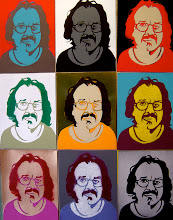
The Portrait: This is a portrait done of me by the artist Jane E. Harrold, A.K.A. Calamity Jane. Besides being a terrific artist, she also makes amazing cowboy shirts, and has a radio program. Look for her on Facebook.
Looking back over the postings in Portrait of the Artist as an Old Man, I realized none of them are very overtly political. Since I consider this blog a self-portrait, that fact is misleading. Actually, I spend a good portion of my time thinking about politics. However, I tend not to enjoy political discussion all that much. It seems to me they either end up being preaching to the choir or trying to score points against someone you have no intention of really listening to. In my experience political discussions close more doors than they open.
Obviously, I’m leading up to writing about politics and I am challenging myself to do it in a way that is personal and invites people in rather than slamming a door in their face.
I just finished reading Blackwater, The Rise of the World’s Most Powerful Mercenary Army by Jeremy Scahill. The gist of what Scahill presents is that Bush came into office with an agenda to “privatize” as much of the federal government as possible, including functions traditionally carried out by the armed services. This was an overt goal that Bush and his neoconservative administration claimed was based on their belief that competition in the market place results in more efficiency than central planning, that corporations, given a free hand, could do everything that government does better and cheaper, including defend the country. Bush, Chaney, and Rumsfeld stated all this before the World Trade Center was destroyed on September 11. After that traumatic event, privatization of the military was put on a fast track so that by the time the US invaded Iraq the State Department and Department of Defense were set up to give out billions of dollars to private corporations to take over functions that had historically been performed by the armed services. Many of these contracts went to a new corporation named Blackwater founded by a man named Erik Prince. Prince was a very wealthy man with deep involvement in right wing political and religious causes.
Not surprisingly, like everything else about the invasion of Iraq, the move to privatize essential military functions went very wrong very quickly. However, it made the people who were awarded the contracts very rich. They profited mightily from the war even as it spiraled downward into chaos. Scahill, whose writing is clear and engaging, tells this story in great detail and with solid documentation. He makes it clear that privatization of the military is a terrible idea, on many, many levels.
My usual response to reading a journalistic expose like this, where powerful people are revealed to be doing terrible things to the rest of us, is anger. I certainly felt anger while reading Blackwater, but much more I felt sadness. I kept muttering to myself, “My poor country. What are they doing to my poor country?”
My most personal connection to the book came as I read about the recruitment and training of Hondurans as mercenaries to send to Iraq. Honduras had initially been part of the “coalition of the willing.” However, it quickly withdrew its regular army troops due to domestic opposition to the war. Despite this decision that the country would not take part in an unpopular war, by 2005 military contractors had set up training bases in the mountains outside Tegucigalpa and were recruiting the same soldiers that Honduras had brought home to go back to Iraq as contracted soldiers. Scahill reports that the Hondurans were paid about $1,000 per month, a small fraction of what people from other parts of the world were being paid to do the same work. So even as cannon fodder, Honduran lives aren’t worth as much as other lives.
I was in Honduras during this period. I had hiked in the mountains where the training base was located. I had no idea what was going on, but I had some contact with the Honduran military and had been thinking and writing about young soldiers.
From my Peace Corps journal- September 25, 2005:
I'm at a Honduran army base in the city of Siquatepeque to give a four-hour presentation on AIDS to the soldiers.This is part of an initiative of the Peace Corps to deliver preventative information to sexually active adult men.I'm at the base with thirty other participants of a “train the trainers” workshop.This is our practicum.
(The manual for the workshop is titled "Aqui Entre Nos... Ideas and Tools for Prevention of HIV/AIDS in the Adult Man." It is illustrated with my Platano Y Tomate drawings.)
We’ve divided up into teams of five and each team is presenting to about fifteen soldiers.I'm working with three Hondurans and another Peace Corps volunteer.
The workshop is fun.It is physically active, packed with games and exercises.The soldiers are having a good time.It has become clear that about half of them can't read or read very poorly.They have trouble counting off by fours.When presented with true or false questions it takes them awhile to realize that the answer will either be true or false.One game involves repeating a well-known tongue twister.Maybe a third of them never manage to say it correctly.They are young and small.Despite the uniforms and the berets worn low over one eye, they strike me as touchingly vulnerable.I'm told later that only the very poor enter the army at this level.If you have more money you can be an officer.These are poor boys from isolated villages a long way from home.
From Siguatepeque, where the Honduran army base is located, it is a twenty-minute bus ride to Comayagua where there is a large American army base.Comayagua is, not coincidentally, a center of prostitution.It is estimated that among prostitutes in Honduras the rate of AIDS infection is 30%.
I'm doing an activity that leads up to the condom demonstration.I ask them to line up in order from the oldest to the youngest with the youngest near the door and the oldest near the window.This relates to condom usage because we are going to give them a sequence of directions for the correct use of a condom and ask them to perform them in order.They like trying to get in order by age, but they can't do it.Two people will ask each other how old they are and stand next to each other, but it won't necessarily relate to the next two.Finally, an officer takes over and organizes them, but when I ask them to go down the line and say how old they are, several are out of order.They think this is very funny, especially the twenty-three year old down between the seventeen and eighteen year olds.Next I ask them to line up by how far their home is from Siguatepeque.Surprisingly they do better at this.There are some energetic discussions about which place is more distant, but in the end they all agree the order is right.I have no way of knowing.Finally, I ask them to form a line with the man with the biggest penis near the door and the man with the smallest penis near the window.The silence lasts three or four beats too long.Then they figure out it is a joke, start laughing, calling for rulers, and jostling to be as near the door as possible.
A young Honduran man named Melvin who came to the workshop with me from Sonaguera takes over and does the condom demonstration.It is soon obvious that many of the soldiers have never seen or handled a condom.They have trouble opening the tin foil packets.They can't figure out which side is up.We are using platanos for penises and they try to put them on with the roll facing the wrong way.
This is all done with great humor, not to mention homoerotic charge.Picture a room full of hot young Latin men holding huge green bananas and helping each other get rubbers over them.
I’m left with the impression that, while it would probably take any of these guys five minutes to get a girl pregnant or infect himself with HIV, their chances of getting a condom on in the dark in a state of excitement are pretty slim.
Perhaps because these boys are young enough to be my grandchildren, all of this strikes me as poignant and some how hopeful.There is so much to do and it needs to happen at such a basic level that it should be possible to make a difference.
I have heard that commercial sex workers charge one price for sex with a condom, but for a little more will let you go "carnita a carnita." At least now, if offered the choice, these soldiers can make an informed decision.That is progress. Right?
("Carnita" is the diminutive of "carne" so it translates as "little meat" or in the phrase for unprotected sex "little meat to little meat."However, the diminutive is used with terms of endearment so perhaps a better translation is "sweet little meat to sweet little meat."I have to admit I like that.)
From my Peace Corps journal – 10/10/05:
I sent out a group email today that described working with a group of Honduras soldiers. (The email was based on the journal entry above.) I wrote about my perception of them as vulnerable young men, poor, uneducated, a long way from their homes and the support of their families. This was an accurate description of my feelings as I stood in front of the group, talking about HIV/AIDS and hoping that the information, to some small extent, would make these young men safer.
However, as I was writing the email a couple of weeks later, another set of more complicated perceptions had crept in.
I’d been reading Inevitable Revolutions by Walter Lafeber. It is a detailed history of the long, sad story of the United States’ exploitation of Central America. For about 200 years now we have had one goal in Central America: profit. We have done anything and everything to keep the balance of cash flowing from South to North. Up until about the 1950’s if anything happened that threatened to interrupt our money making, we literally sent in the marines with few if any apologies or rationalizations. In the 1950s and 60s, in the context of the cold war, with the Soviet Union and China emerging as rival super powers, direct, armed intervention in the internal affairs of Central American democracies became harder to pull off. Our solution was to choose a right wing politician or general, covertly support him in overthrowing the legitimate government, buy him an army and auxiliary paramilitaries, train them at The School of The Americas, arm them to the teeth and turn them loose on their own people. Thus assuring that Central America was a “stable” place for US corporations to make big bucks. Due to this arrangement, hundreds of thousands of Central Americans, especially during the 1980’s and 90’s, were tortured, “disappeared”, lined up on the edges of mass graves and shot in the back of the head, herded into churches that were then burned to the ground, dropped out of airplanes and helicopters, etc.
Inevitable Revolutions, among many other books, tells this history at much greater length, in minute detail, in more academic language, but there is no mistaking that this is the story.
The soldiers who did the killing across Central America must have been just like the sweet, not very bright boys I gave the AIDS workshop to. The victims of the killing were for the mot part poor and powerless, just like the killers themselves.
What is the greater sin, for a boy to be a murderer or to turn a boy into a murderer? I’m glad I don’t have to come up with the answer to that question.
(Speaking of great sin, John Negroponte was US ambassador to Honduras during the 1980s, but his responsibility for the process described above was much greater and included overseeing the US’ bloody role in Nicaragua and Salvador. In 2004 he was appointed ambassador to Iraq. Scahil suggests that his appointment was made with the goal of implementing the “Salvador Option”: getting Iraqis to kill other Iraqis.)
I read the last page of Blackwater and closed the cover. How can it be that this information is available in such an accessible form and nothing changes?
But maybe there is some reason to be hopeful after all. From the New York Times, June 8, 2010
WASHINGTON — Burdened by lawsuits, criminal investigations and negative publicity stemming from its private security work in Iraq and Afghanistan, Blackwater Worldwide is being put up for sale, the company has announced.
Blackwater, which changed its name to Xe Services and brought in new management last year in order to remake its image, is pursuing a sale in part because that overhaul has failed to change perceptions of the company, most critically inside government, which is its main customer.
Erik Prince, the former member of the Navy Seals and heir to an automotive fortune who founded Blackwater, said in a statement given to The Associated Press late Monday that making the decision to sell the company was difficult, but that he no longer wanted to deal with the intense criticism the business has faced.